Tuesday, March 1, 2022
Artist of the First (or Second) Modern Graphic Novel
Monday, February 21, 2022
Auteurs of the Graphic Novel
Nowadays every issue of a comic book is a temporarily embarrassed graphic novel.
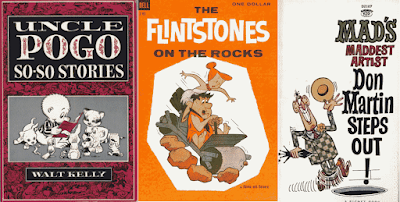
My definition of graphic novel: A book using original comics material in narrative. The important word here is book, so length isn't a criterion--"novel" encompasses collections (like A Contract with God, by the way). A magazine isn't a book, so His Name Is Savage, for instance, doesn't meet the definition. And if it isn't limited to original material, the floodgates open for an appalling number of titles from comic strips and comic books. Note that these three Pogo books are the original-material ones among, otherwise, collections. I say "in narrative" to omit single-page gags of the "talking in pictures" sort, although fumetti would otherwise fit--for instance, in the 70s, Richard J. Anobile's Fotonovels. (And so if we were including magazines, Charlton's 1963 full-length Black Zoo would predate the 1968 His Name Is Savage anyway.)
Mansion of Evil and It Rhymes with Lust are each dated just 1950, so which one is the first modern graphic novel is a question--but it's one or the other.
I'm pushing the definition of "original" with Passionella, but one of the four stores is original and the others have been revised and redrawn for the book. I dithered over the six 1962 Tintin books form Golden Press--they are new American translations--and decided not to include them. Belmont's High Camp Superheroes and My Son the Teenager I left off too, as the new material in them was prepared for the comics and by luck came out in the paperbacks first.
Can you think of any I'm missing through 1970? UPDATE--2 days later--The Monkees occurred to me when I happened to be thinking of the more usual TV tie-in comics and novels. FURTHER UPDATE: OtherEric in his comment contributed The Pogo Poop Book.
1940s-60s American Graphic Novels
abbreviations: mass market paperbacks, hardcovers, trade paperbacks
| 1950 | Mansion of Evil | Fawcett | pb |
| It Rhymes with Lust | St. John | digest | |
| 1953 | Uncle Pogo So-So Stories | S&S | hc, tp |
| 1954 | The Pogo Stepmother Goose | S&S | tp |
| 1955 | The Pogo Peek-a-Book | S&S | hc, tp |
| 1959 | Passionella and Other Stories | McGraw-Hill | tp |
| Harvey Kurtzman's Jungle Book | Ballantine | pb | |
| 1960 | The Flintstones on the Rocks | Dell | small tp |
| Huck and Yogi Jamboree | Dell | small tp | |
| 1962 | Don Martin Steps Out | Signet | pb |
| [and many more MAD originals] | |||
| 1966 | Christopher Lee's Treasury of Terror | Pyramid | pb |
| Dracula | Ballantine | pb |
|
| The Monkees | Popular Library | pb |
|
| The Great Society Comic Book | Parallax | small tp | |
| Bobman and Teddy | Parallax | small tp | |
| Kosher Comics | Parallax | small tp | |
| The Pogo Poop Book | S&S | tp | |
| 1967 | The Man from M.O.T.H.E.R. | Parallax | smaller tp |
Saturday, January 22, 2022
Dick Wood and Mr. Crime
Dick Wood was credited for any number of stories in Crime Does Not Pay at Lev Gleason, but by no means all. This is a list of his anonymous ones that I've found. There are CDNP issues missing here that haven't been scanned yet. Scarce due to Forties paper drives? Fifties comic book burnings?
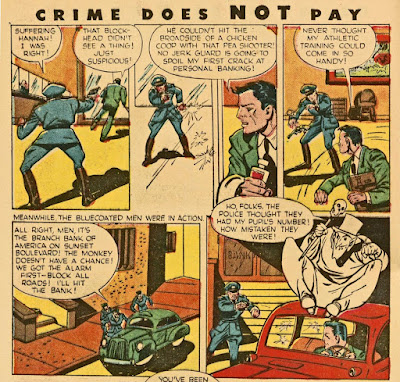
Dick Wood is recognizable by expressions like "Suffering Hannah," and in Crime Does Not Pay he has an even easier-to-spot characteristic on some stories. Starting with the bylined story "The True Life Story of 'Pretty Boy Floyd'" leading off #27, when he uses narrator Mr. Crime, very often the latter prefaces a speech or caption with "Ho, folks," or "Ho, Pretty Boy" to the protagonist, or just "Ho," all with a comma--"Ho, and where is he now?" The tiers are from the bylined story "One-Man Crime Wave" in #35.
I've mentioned Wood's use of the exclamation "Kazar" in The Claw, Jigsaw, and The Phantom; here he uses it in, for instance, "The True Story of Jean Cavillac" in #31 and "Wild Beasts of Paris" in #38--and it's after seeing it here that I realize it's meant for "Huzzah."
Dick Wood scripts without byline
in CRIME DOES NOT PAY
| May/ | 27 | The Dead-Eye Romeo |
| The Strange Saga of Rafael Red Lopez | ||
| Sep/ | 29 | The True Story of "Two-Gun" Crowley |
| Nov/ | 30 | The Texas Terrors |
| Crime Close-Ups | ||
| Jan/44 | 31 | The True Story of Jean Cavillac |
| The Million Dollar Robbery | ||
| Mar/ | 32 | The Man Who Loved Murder |
| SeƱorita of Sin | ||
| Playboys of Crime | ||
| Jan/45 | 37 | 10 Years of Terror: Vincent Piazzero |
| Case of the Confident Killer | ||
| The Singing Slayer | ||
| Mar/ | 38 | The Meek Murderer |
| Murder by Night | ||
| Wild Beasts of Paris | ||
| May/ | 39 | Blonde Queen of Crime |
| The Case of the Tell-Tale Watch | ||
| The Crime of Terry Almodovar | ||
| Sep/ | 41 | The Cocksure Counterfeiter |
| Who Dunnit? | ||
| Jan/46 | 43 | Case of the Love Sick Clown |
| Doctor of Evil | ||
| Mar/ | 44 | The True Story of "Legs" Diamond |
| Death on the Tracks | ||
| May/ | 45 | The True Story of John Dillinger |
| The Fire Fiend | ||
| Crime of the Friendly Enemy | ||
| Sep/ | 47 | Thug's Throne |
| The Horrible Halzingers | ||
| Jan/47 | 49 | The Case of the Voodooed Hangars |
| Mar/ | 50 | The Belmont Bandit |
Monday, January 3, 2022
A Harvey Gh-gh-ghost on Bunny
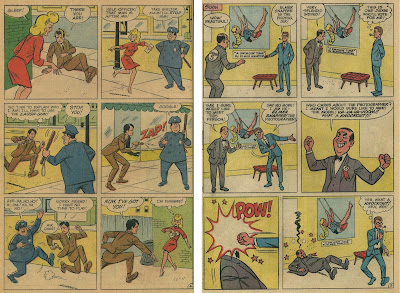
And since Eisman is the main artist, when there are figures (of secondary characters) in another artist's style, I'm going to say that artist was assisting Eisman unknown to the Harvey editors and thus a ghost. The artist I see is Gus Lemoine from Archie (most notably Madhouse). These pages are from "O. O. Heaven" and "The Playpen Contest."
Upon my first look I went along with the GCD, wondering if there were unknown artists on a few early stories, but I think it's the inconsistency in inking styles among different stories before one style is settled upon with issue #3. (Eisman himself or other inkers? I can't tell.) I'd give the main pencilling credit on all "Bunny family" stories to Eisman.
Bunny pencil assists by Gus Lemoine
| Dec/66 | 1 | Rookie Secret Agent O. O. Heaven |
| Discarteque | ||
| The Mush Meal Caper | ||
| Tiger Bunny | ||
| The Playpen Contest | ||
| Apr/67 | 2 | The Ultrazaric Decodifier |
Monday, December 6, 2021
Jack Oleck in Marvel Tales and Journey into Mystery
The main writer for the Atlas fantasy anthologies by this time is Carl Wessler, with rather more stories than Oleck; Wessler's are known from Robin Snyder's transcribing the writer's records in History of the Comics.
Marvel Tales was cancelled with #159 in the Atlas Implosion in 1957; Journey into Mystery was too, with #47, but was reinstated a year later with a few issues out of inventory (although no Oleck scripts) before the beginning of the proto-Marvel lineup (much more work from Jack Kirby, for one) leading into the monster phase.
Jack Oleck scripts
in Journey into Mystery
| Aug/56 | #37 | The Voice in the Night |
| Nov/ | #40 | How Harry Escaped |
| Dec/ | #41 | I Switched Bodies |
| Jan/57 | #42 | Humans...Keep Out! |
| Feb/
|
#43 | It's Waiting for Me |
| Apr/ | #45 | What Happened to Harrison |
| May/ | #46 | Voodoo |
| June/ | #47 | Bring Back My Body |
| He Sits in the Fog! |
in Marvel Tales
| July/56 | #148 | The Despot |
| Aug/ | #149 | The Thief |
| Nov/ | #152 | When Mongorr Appeared |
| Dec/ | #153 | It Can't Be Done! |
| |
The Last Man Alive | |
| Feb/57 | #155 | Man in a Trance |
| Mar/ | #156 | Forbidden...Keep Out! |
| Apr/ | #157 | The Man Who Was
Replaced |
| The Man Who Changed | ||
| Aug/ | #159 | The Last Look |
Wednesday, November 17, 2021
A Mysterious Script
When I tried searching for the name of the protagonist, Les Everhurd, on the Grand Comics Database, I came up with nothing; he hadn't been entered as a character. Finally--a few days ago--I Googled the name, and found it elsewhere on the Internet--MyComicShop did enter Everhurd's name in the description. That guessed-at "Productions" may be "Lev Gleason Publiactions"--with the a and the c switched in the heat of typing. The instructions to the artist to leave the top third of the page blank show that this was commissioned as a lead story, as that's where that warning box went for a few months in the Lev Gleason books.
Interestingly enough, although this is supposed to be the only existing copy of the script, it doesn't show any of the editing done to the dialog/caption before it got lettered. In fact all the dialog was dropped, but most of it Frohman reuses when this scene appears toward the end of the story.
Burt Frohman Script Seen Online
Crime and Punishment--Lev Gleason
| Nov/52 | #56 | A Dame Deals Death |
Friday, October 22, 2021
A Crossover in Prose and an Homage Cover
Having posted on the American Perry Rhodan book series for some swipes in the covers, I'm turning to the original digest series in German prose and another such series begun decades later.
The Perry Rhodan #1 (Sept 8, 1961) cover is by Johnny Bruck and the Maddrax #523 (Feb 4, 2020) one is by NƩstor Taylor for that series' 20th anniversary. A reproduction of the Bruck cover is included in the Maddrax digest just to make it obvious the new cover is an homage.
Perry Rhodan's story begins when, making the first landing on the Moon in 1971, he brings back advanced technology from a stranded ship of the Arkonide star empire in order to prevent World War III and then protect Earth from possible alien invasion. In his series, Matt Drax undergoes a Buck Rogers transition into the post-apocalyptic future and at this point in his adventures is on an Earth littered with pockets of parallel worlds.
Needless to say, Maddrax and his companions enter 1971 and meet Rhodan and company just back from the Moon (thus actually in the second issue of PR, "Die Dritte Macht"--"The Third Power.") By the end of the story, Rhodan's memory is wiped of the encounter--if that reminds you of any comic book time-travel crossovers. Also in the comic book way, this is a cross-company crossover.
"Crossover" was written by Oliver Frƶhlich, and the first two Perry Rhodans by, respectively, K. H. Scheer and Clark Darlton. Perry Rhodan is at issue #3140, having been published weekly all this time.