Monday, April 25, 2022

Robert Bernstein Writes Desperado

This is a way of dipping my toe in the water on Robert Bernstein's scripts for Lev Gleason; he was a major writer for them mostly after Dick Wood (their tenures overlapped in 1946-47) and alongside Carl Wessler and others. There may well be more Bernstein stories here that didn't jump out at me if he didn't use his typical exclamations.

Desperado not surprisingly is spun off Crime Does Not Pay as an anthology of nothing but Wild West crime stories after CDNP ran them every so often. With #9 Desperado became the Western masked hero book Black Diamond Western.

In lieu of CDNP's Mr. Crime, the lead story of most issues of Desperado was narrated by an object--a gallows, a coin, a boot--long before that became a staple of the DC war books. Here a gun is narrating "Joe Slade" in #1.


Desperado Anthology Stories
Written by Robert Bernstein


June/48 Joe Slade
    Sam Bass, the Cross Eyed Dead Shot
Aug/     Teton Jackson
Sep/     The Hole-in-the-Wall Gang and Its Leader "Kid" Curry
    Crazy Sam Brown
    Johnny Ringo
Oct/     "Doc" Holliday
    Wes Hardin
Nov/     King Hunter, the Self-Proclaimed King
    Clay Cottrell
    "Rattlesnake Jake" Fallon
    Bat Slater
Dec/     Joe Bowler
    Sheriff Ted Tucker
    Burly Will Grady and His Band of Ruthless Rustlers
Jan/49  One Man Against Two Armies
    "Buckskin" Frank Combs
    [WESTERN WHODUNNIT?]
Feb/      Cesar Leporello and the Phony Diamond of the Rio Grande
    Fools' Gold
    Blind Man's Bluff

Tuesday, March 29, 2022

Mix-and-Match Swipe

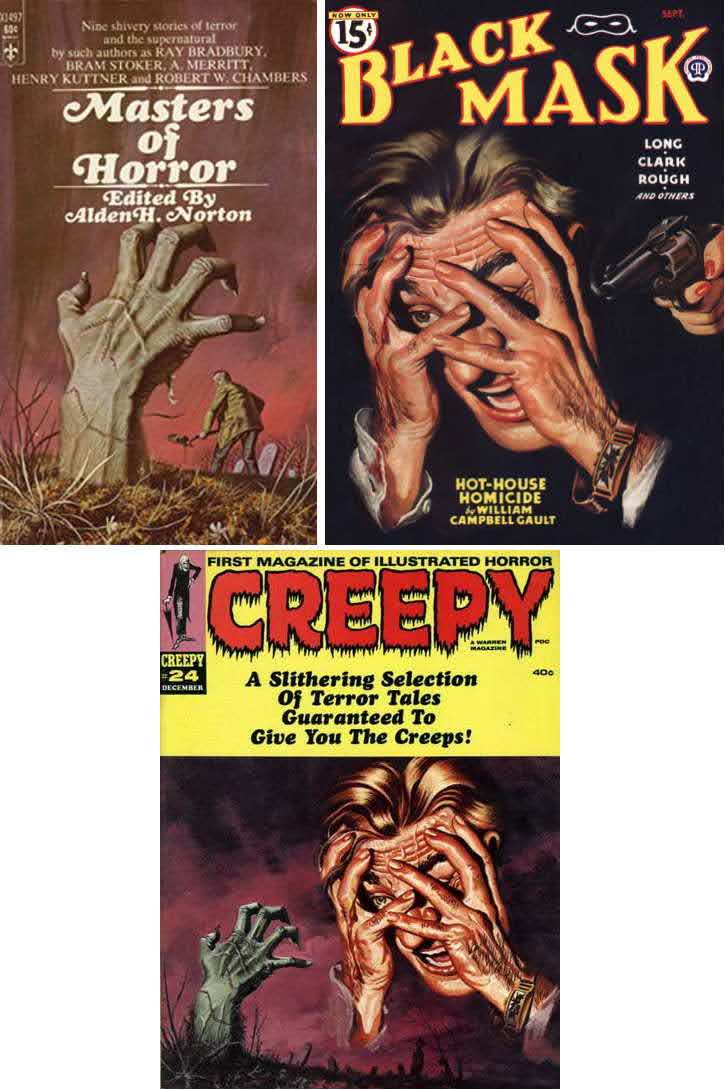
Gutenberg Montiero's cover painting for Creepy 24 (Dec/68) swipes two earlier paintings.

Masters of Horror pb, Black Mask Sept 46, Creepy 24

An unknown artist painted the cover for the Berkley paperback Masters of Horror (1967); Rafael De Soto painted the one for the pulp magazine Black Mask (Sept/46).

Tuesday, March 1, 2022

Artist of the First (or Second) Modern Graphic Novel

1950's Mansion of Evil from Fawcett Gold Medal Books is credited only to the scripter, Joseph Millard. The artist is Bud Thompson. The tiers below, from the story "Guilty of Murder" in the final issue of Fawcett's Captain Marvel Jr.--#119, June 1953--show some of the same silhouetted or partially silhouetted figures as in Mansion of Evil.

Mansion of Evil, CMJ 119

The previous guess on the Mansion of Evil art is George Evans--but only on two of the eleven chapters, when the style is the same throughout.

Monday, February 21, 2022

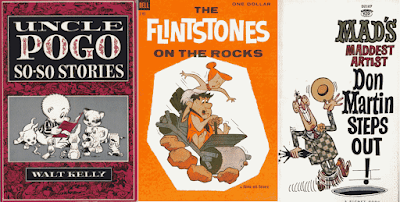
Auteurs of the Graphic Novel

Uncle Pogo So-So Stories, Theb Flintstones on the Rocks, Don Martin Steps Out

Nowadays every issue of a comic book is a temporarily embarrassed graphic novel.

My definition of graphic novel: A book using original comics material in narrative. The important word here is book, so length isn't a criterion--"novel" encompasses collections (like A Contract with God, by the way). A magazine isn't a book, so His Name Is Savage, for instance, doesn't meet the definition. And if it isn't limited to original material, the floodgates open for an appalling number of titles from comic strips and comic books. Note that these three Pogo books are the original-material ones among, otherwise, collections. I say "in narrative" to omit single-page gags of the "talking in pictures" sort, although fumetti would otherwise fit--for instance, in the 70s, Richard J. Anobile's Fotonovels. (And so if we were including magazines, Charlton's 1963 full-length Black Zoo would predate the 1968 His Name Is Savage anyway.)

Mansion of Evil and It Rhymes with Lust are each dated just 1950, so which one is the first modern graphic novel is a question--but it's one or the other.

I'm pushing the definition of "original" with Passionella, but one of the four stores is original and the others have been revised and redrawn for the book. I dithered over the six 1962 Tintin books form Golden Press--they are new American translations--and decided not to include them. Belmont's High Camp Superheroes and My Son the Teenager I left off too, as the new material in them was prepared for the comics and by luck came out in the paperbacks first.

Can you think of any I'm missing through 1970? UPDATE--2 days later--The Monkees occurred to me when I happened to be thinking of the more usual TV tie-in comics and novels. FURTHER UPDATE: OtherEric in his comment contributed The Pogo Poop Book.

1940s-60s American Graphic Novels
abbreviations: mass market paperbacks, hardcovers, trade paperbacks

1950  Mansion of Evil  Fawcett pb
   It Rhymes with Lust St. John digest
1953  Uncle Pogo So-So Stories S&S hc, tp
1954  The Pogo Stepmother Goose S&S tp
1955  The Pogo Peek-a-Book S&S hc, tp
1959  Passionella and Other Stories McGraw-Hill tp
  Harvey Kurtzman's Jungle Book Ballantine pb
1960  The Flintstones on the Rocks Dell small tp
  Huck and Yogi Jamboree Dell small tp
1962  Don Martin Steps Out Signet pb
    [and many more MAD originals]
1966  Christopher Lee's Treasury of Terror Pyramid pb
  Dracula Ballantine pb
  The Monkees Popular Library pb
  The Great Society Comic Book Parallax small tp
  Bobman and Teddy Parallax small tp
  Kosher Comics Parallax small tp
  The Pogo Poop Book S&S tp
1967  The Man from M.O.T.H.E.R. Parallax smaller tp

Saturday, January 22, 2022

Dick Wood and Mr. Crime

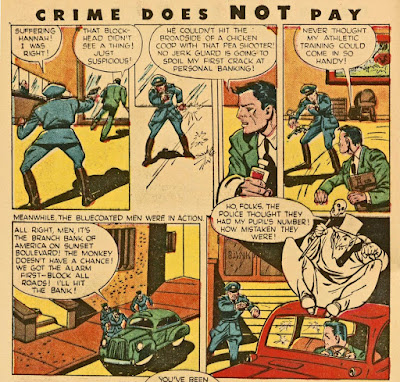
CDNP 35 'Suffering Hannah,' 'Ho, folks'

Dick Wood was credited for any number of stories in Crime Does Not Pay at Lev Gleason, but by no means all. This is a list of his anonymous ones that I've found. There are CDNP issues missing here that haven't been scanned yet. Scarce due to Forties paper drives? Fifties comic book burnings?

Dick Wood is recognizable by expressions like "Suffering Hannah," and in Crime Does Not Pay he has an even easier-to-spot characteristic on some stories. Starting with the bylined story "The True Life Story of 'Pretty Boy Floyd'" leading off #27, when he uses narrator Mr. Crime, very often the latter prefaces a speech or caption with "Ho, folks," or "Ho, Pretty Boy" to the protagonist, or just "Ho," all with a comma--"Ho, and where is he now?" The tiers are from the bylined story "One-Man Crime Wave" in #35.

I've mentioned Wood's use of the exclamation "Kazar" in The Claw, Jigsaw, and The Phantom; here he uses it in, for instance, "The True Story of Jean Cavillac" in #31 and "Wild Beasts of Paris" in #38--and it's after seeing it here that I realize it's meant for "Huzzah."

Dick Wood scripts without byline
in CRIME DOES NOT PAY

May/   27  The Dead-Eye Romeo
    The Strange Saga of Rafael Red Lopez
Sep/   29  The True Story of "Two-Gun" Crowley
Nov/    30  The Texas Terrors
    Crime Close-Ups
Jan/44 31  The True Story of Jean Cavillac
    The Million Dollar Robbery
Mar/    32  The Man Who Loved Murder
    SeƱorita of Sin
    Playboys of Crime
Jan/45 37  10 Years of Terror: Vincent Piazzero
    Case of the Confident Killer
    The Singing Slayer
Mar/     38  The Meek Murderer
    Murder by Night
    Wild Beasts of Paris
May/     39  Blonde Queen of Crime
    The Case of the Tell-Tale Watch
    The Crime of Terry Almodovar
Sep/     41  The Cocksure Counterfeiter
    Who Dunnit?
Jan/46 43  Case of the Love Sick Clown
    Doctor of Evil
Mar/     44  The True Story of "Legs" Diamond
    Death on the Tracks
May/     45  The True Story of John Dillinger
    The Fire Fiend
    Crime of the Friendly Enemy
Sep/      47  Thug's Throne
    The Horrible Halzingers
Jan/47  49  The Case of the Voodooed Hangars
Mar/      50  The Belmont Bandit

Monday, January 3, 2022

A Harvey Gh-gh-ghost on Bunny

Bunny_Lemoine The only attribution at the moment for the art on Harvey's Sixties teen-type title Bunny is Hy Eisman. His sneak signature is in a number of early stories in the form of the license plate "Hy 27 E" on four different cars in "Discarteque" (#1), "The Ultrazaric Decodifier," "Guests from England," and "Poetic Justice" (#2); the "27" (Eisman's birthday) is on photographer Elmer Snapple's door in "The Playpen Contest" (#1) and it continues on his door in, for instance, "The 'Zoople' Contest" (#2).

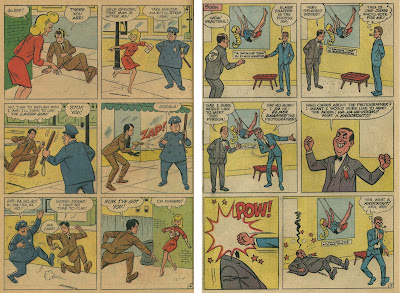
Bunny 1 O. O. Heaven, Playpen Contest

And since Eisman is the main artist, when there are figures (of secondary characters) in another artist's style, I'm going to say that artist was assisting Eisman unknown to the Harvey editors and thus a ghost. The artist I see is Gus Lemoine from Archie (most notably Madhouse). These pages are from "O. O. Heaven" and "The Playpen Contest."

Upon my first look I went along with the GCD, wondering if there were unknown artists on a few early stories, but I think it's the inconsistency in inking styles among different stories before one style is settled upon with issue #3. (Eisman himself or other inkers? I can't tell.) I'd give the main pencilling credit on all "Bunny family" stories to Eisman.

Bunny pencil assists by Gus Lemoine

Dec/66 Rookie Secret Agent O. O. Heaven
    Discarteque
    The Mush Meal Caper
    Tiger Bunny
    The Playpen Contest
Apr/67 The Ultrazaric Decodifier

Monday, December 6, 2021

Jack Oleck in Marvel Tales and Journey into Mystery

Jack Oleck's writing style is recognizable in the Had-He-But-Known phrasing on the first page of his first story for Atlas's Journey into Mystery: Monty could still think, then...he could still reason...

Voice in the Night JIM 37

The main writer for the Atlas fantasy anthologies by this time is Carl Wessler, with rather more stories than Oleck; Wessler's are known from Robin Snyder's transcribing the writer's records in History of the Comics.

Marvel Tales was cancelled with #159 in the Atlas Implosion in 1957; Journey into Mystery was too, with #47, but was reinstated a year later with a few issues out of inventory (although no Oleck scripts) before the beginning of the proto-Marvel lineup (much more work from Jack Kirby, for one) leading into the monster phase.

Jack Oleck scripts
in Journey into Mystery


Aug/56 #37  The Voice in the Night
Nov/      #40  How Harry Escaped
Dec/      #41  I Switched Bodies
Jan/57 #42  Humans...Keep Out!
Feb/    
#43  It's Waiting for Me
Apr/      #45  What Happened to Harrison
May/     #46  Voodoo
June/      #47  Bring Back My Body


He Sits in the Fog!

in Marvel Tales

July/56 #148  The Despot
Aug/      #149  The Thief
Nov/      #152  When Mongorr Appeared
Dec/      #153  It Can't Be Done!
 
  The Last Man Alive
Feb/57 #155  Man in a Trance
Mar/     #156  Forbidden...Keep Out!
Apr/      #157  The Man Who Was Replaced


The Man Who Changed
Aug/      #159  The Last Look