Saturday, January 22, 2022

Dick Wood and Mr. Crime

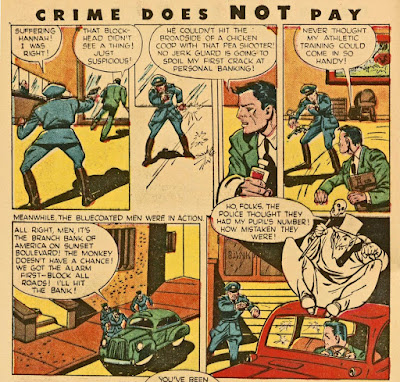
CDNP 35 'Suffering Hannah,' 'Ho, folks'

Dick Wood was credited for any number of stories in Crime Does Not Pay at Lev Gleason, but by no means all. This is a list of his anonymous ones that I've found. There are CDNP issues missing here that haven't been scanned yet. Scarce due to Forties paper drives? Fifties comic book burnings?

Dick Wood is recognizable by expressions like "Suffering Hannah," and in Crime Does Not Pay he has an even easier-to-spot characteristic on some stories. Starting with the bylined story "The True Life Story of 'Pretty Boy Floyd'" leading off #27, when he uses narrator Mr. Crime, very often the latter prefaces a speech or caption with "Ho, folks," or "Ho, Pretty Boy" to the protagonist, or just "Ho," all with a comma--"Ho, and where is he now?" The tiers are from the bylined story "One-Man Crime Wave" in #35.

I've mentioned Wood's use of the exclamation "Kazar" in The Claw, Jigsaw, and The Phantom; here he uses it in, for instance, "The True Story of Jean Cavillac" in #31 and "Wild Beasts of Paris" in #38--and it's after seeing it here that I realize it's meant for "Huzzah."

Dick Wood scripts without byline
in CRIME DOES NOT PAY

May/   27  The Dead-Eye Romeo
    The Strange Saga of Rafael Red Lopez
Sep/   29  The True Story of "Two-Gun" Crowley
Nov/    30  The Texas Terrors
    Crime Close-Ups
Jan/44 31  The True Story of Jean Cavillac
    The Million Dollar Robbery
Mar/    32  The Man Who Loved Murder
    Señorita of Sin
    Playboys of Crime
Jan/45 37  10 Years of Terror: Vincent Piazzero
    Case of the Confident Killer
    The Singing Slayer
Mar/     38  The Meek Murderer
    Murder by Night
    Wild Beasts of Paris
May/     39  Blonde Queen of Crime
    The Case of the Tell-Tale Watch
    The Crime of Terry Almodovar
Sep/     41  The Cocksure Counterfeiter
    Who Dunnit?
Jan/46 43  Case of the Love Sick Clown
    Doctor of Evil
Mar/     44  The True Story of "Legs" Diamond
    Death on the Tracks
May/     45  The True Story of John Dillinger
    The Fire Fiend
    Crime of the Friendly Enemy
Sep/      47  Thug's Throne
    The Horrible Halzingers
Jan/47  49  The Case of the Voodooed Hangars
Mar/      50  The Belmont Bandit

Monday, January 3, 2022

A Harvey Gh-gh-ghost on Bunny

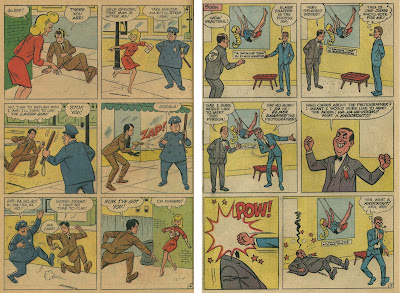
Bunny_Lemoine The only attribution at the moment for the art on Harvey's Sixties teen-type title Bunny is Hy Eisman. His sneak signature is in a number of early stories in the form of the license plate "Hy 27 E" on four different cars in "Discarteque" (#1), "The Ultrazaric Decodifier," "Guests from England," and "Poetic Justice" (#2); the "27" (Eisman's birthday) is on photographer Elmer Snapple's door in "The Playpen Contest" (#1) and it continues on his door in, for instance, "The 'Zoople' Contest" (#2).

Bunny 1 O. O. Heaven, Playpen Contest

And since Eisman is the main artist, when there are figures (of secondary characters) in another artist's style, I'm going to say that artist was assisting Eisman unknown to the Harvey editors and thus a ghost. The artist I see is Gus Lemoine from Archie (most notably Madhouse). These pages are from "O. O. Heaven" and "The Playpen Contest."

Upon my first look I went along with the GCD, wondering if there were unknown artists on a few early stories, but I think it's the inconsistency in inking styles among different stories before one style is settled upon with issue #3. (Eisman himself or other inkers? I can't tell.) I'd give the main pencilling credit on all "Bunny family" stories to Eisman.

Bunny pencil assists by Gus Lemoine

Dec/66 Rookie Secret Agent O. O. Heaven
    Discarteque
    The Mush Meal Caper
    Tiger Bunny
    The Playpen Contest
Apr/67 The Ultrazaric Decodifier

Monday, December 6, 2021

Jack Oleck in Marvel Tales and Journey into Mystery

Jack Oleck's writing style is recognizable in the Had-He-But-Known phrasing on the first page of his first story for Atlas's Journey into Mystery: Monty could still think, then...he could still reason...

Voice in the Night JIM 37

The main writer for the Atlas fantasy anthologies by this time is Carl Wessler, with rather more stories than Oleck; Wessler's are known from Robin Snyder's transcribing the writer's records in History of the Comics.

Marvel Tales was cancelled with #159 in the Atlas Implosion in 1957; Journey into Mystery was too, with #47, but was reinstated a year later with a few issues out of inventory (although no Oleck scripts) before the beginning of the proto-Marvel lineup (much more work from Jack Kirby, for one) leading into the monster phase.

Jack Oleck scripts
in Journey into Mystery


Aug/56 #37  The Voice in the Night
Nov/      #40  How Harry Escaped
Dec/      #41  I Switched Bodies
Jan/57 #42  Humans...Keep Out!
Feb/    
#43  It's Waiting for Me
Apr/      #45  What Happened to Harrison
May/     #46  Voodoo
June/      #47  Bring Back My Body


He Sits in the Fog!

in Marvel Tales

July/56 #148  The Despot
Aug/      #149  The Thief
Nov/      #152  When Mongorr Appeared
Dec/      #153  It Can't Be Done!
 
  The Last Man Alive
Feb/57 #155  Man in a Trance
Mar/     #156  Forbidden...Keep Out!
Apr/      #157  The Man Who Was Replaced


The Man Who Changed
Aug/      #159  The Last Look

Wednesday, November 17, 2021

A Mysterious Script

Writer Burt Frohman kept records by filing away his comic-book scripts with copies of the issues they were published in; when the Frohman collection was sold off, the scripts were included with the relevant comics. Doc V. shows a few Frohman scripts for Atlas in his Timely-Atlas-Comics post on Stan Lee in the Timely years (use Find twice for Frohman).
This is a script page that was on the Internet by itself (at this point I can't recall where); the stapled-on note to the artist creates a problem in connecting the script with the published story, as the note covers up most of the recipient and the title. The publisher name seems to end in "Productions." (Click for a better view).

A Dame Deals Death, C&P 56

When I tried searching for the name of the protagonist, Les Everhurd, on the Grand Comics Database, I came up with nothing; he hadn't been entered as a character. Finally--a few days ago--I Googled the name, and found it elsewhere on the Internet--MyComicShop did enter Everhurd's name in the description. That guessed-at "Productions" may be "Lev Gleason Publiactions"--with the a and the c switched in the heat of typing. The instructions to the artist to leave the top third of the page blank show that this was commissioned as a lead story, as that's where that warning box went for a few months in the Lev Gleason books.

Interestingly enough, although this is supposed to be the only existing copy of the script, it doesn't show any of the editing done to the dialog/caption before it got lettered. In fact all the dialog was dropped, but most of it Frohman reuses when this scene appears toward the end of the story.

Burt Frohman Script Seen Online

Crime and Punishment--Lev Gleason

Nov/52 #56  A Dame Deals Death


Friday, October 22, 2021

A Crossover in Prose and an Homage Cover

Having posted on the American Perry Rhodan book series for some swipes in the covers, I'm turning to the original digest series in German prose and another such series begun decades later.

Perry Rhodan #1 and Maddrax Homage

The Perry Rhodan #1 (Sept 8, 1961) cover is by Johnny Bruck and the Maddrax #523 (Feb 4, 2020) one is by Néstor Taylor for that series' 20th anniversary. A reproduction of the Bruck cover is included in the Maddrax digest just to make it obvious the new cover is an homage.

Perry Rhodan's story begins when, making the first landing on the Moon in 1971, he brings back advanced technology from a stranded ship of the Arkonide star empire in order to prevent World War III and then protect Earth from possible alien invasion. In his series, Matt Drax undergoes a Buck Rogers transition into the post-apocalyptic future and at this point in his adventures is on an Earth littered with pockets of parallel worlds.

Needless to say, Maddrax and his companions enter 1971 and meet Rhodan and company just back from the Moon (thus actually in the second issue of PR, "Die Dritte Macht"--"The Third Power.") By the end of the story, Rhodan's memory is wiped of the encounter--if that reminds you of any comic book time-travel crossovers. Also in the comic book way, this is a cross-company crossover. 

"Crossover" was written by Oliver Fröhlich, and the first two Perry Rhodans by, respectively, K. H. Scheer and Clark Darlton. Perry Rhodan is at issue #3140, having been published weekly all this time.


Wednesday, September 29, 2021

Another Hidden Penciller

Falling in Love 122

Click it to see the double page at a better size. This is another case of a rather overpowering inker hiding the penciller's style is "I Want to Be Free--to Live, to Love" in DC's Falling in Love 122 (Apr/71). The Grand Comics Database suggests Tony deZuñiga is inking himself. But try to picture the pencils without the distraction of deZuñiga's very distinctive style; this artist usually inked himself through the Sixties. Take a moment to look for the characteristic poses in a number of panels, before going to the second page where I've named him.

Monday, September 6, 2021

A Trapani Ghost on the Ghost Who Walks, and Writers

'What the!!?!?!?'

"The Secret of the Golden Ransom" in Charlton's first issue of The Phantom--#30--may or may not have been a ghosting job as far as the editors knew, but it certainly ended up one for fandom, as the pencils as well as the inks have ever since been attributed to Sal Trapani. The penciller is José Delbo, artist on Billy the Kid at Charlton at the time.

The script was evidently passed along out of inventory from King, like Gary Poole's in the same issue and Dick Wood's in the next few. The writer is Pat Fortunato, who wrote the earlier Girl Phantom story, "The Riddle of the Witch," in #24. Note the profusion of exclamation points and question marks in one panel; this would be a noticeable characteristic of Fortunato's work in her credited (and uncredited) work on UFO Flying Saucers at Gold Key.

This post was just going to ID that one Charlton story, but upon seeing how other issues have been attributed on the Grand Comics Database, I ended expanding it by a lot. On the Gold Key issues, the GCD notes that some 40 years after these were published, Bill Harris said he wrote all the Phantom stories. The Comic Reader 40 is cited for attributing the story in #11 as by "Dick Wood?" in addition to "Bill Harris?" That story's note does suggest that actually Harris said he wrote the adaptations of Lee Falk strip stories, which makes more sense. TCR 32 also mentions Wood: "Dick Wood is still scripting SOLAR, and he'll be handling the original PHANTOM scripts." The source of the contemporary Gold Key news at TCR? Gold Key editor Bill Harris.

For your perusal: panels from the Claw story in Daredevil Comics 22 (Feb/46, Lev Gleason), "Interplanetary Olympics" in Jigsaw 2 (Dec/66, Harvey), and "The Terror Tiger" in Phantom 21, all with the use of "Kazar" for "Huzzah"--like "Great suffering Hannah" elsewhere, a sign of Dick Wood's scripting.

'Kazar!'

I suppose most of the stories not listed here through #30 are indeed by Bill Harris.

Some Phantom writers
Gold Key/King/Charlton


Apr/65 11  Blind Man's Bluff Dick Wood
June/    12  The Beast of Bengali Wood
Aug/    13  The Phantom Chronicles Wood
Nov/66 19  The Astronaut and the Pirates Wood
  The Masked Emissary Wood
Jan/67 20  The Adventures of the Girl Phantom Wood
  The Invisible Demon Jerry Siegel
Mar/    21  The Terror Tiger Wood
Mar/    22  The Secret of Magic Mountain Wood
Mar/    23  Delilah Wood
Aug/    24  The Riddle of the Witch Pat Fortunato
Oct/    26  The Pearl Raiders Wood
Nov/    27  The Story of Hero Gary Poole
Dec/    28  Diana's Deadly Tour Wood
Feb/69 30  The Secret of the Golden Ransom Fortunato
 
p: José Delbo  i: Sal Trapani

in Mandrake the Magician
King


Nov/66 The Pirate Raiders Wood
Mar/67 The Girl Phantom Wood